5-Inch vs. 6-Inch Gutters: What Size Does an Upstate NY Home Need?
By the S&T Seamless team, Utica NY · Published 2026-09-22 · Last updated October 2026
Most Upstate NY homes do fine with 5-inch K-style gutters, ideally paired with larger 3x4 downspouts. Choose 6-inch gutters with 3x4 downspouts for large roof areas, steep pitches (about 9/12 and up), long runs, metal roofs, or any run below a valley. In Central NY, 5-inch typically costs $9–$15 per foot installed and 6-inch $12–$20. Bigger gutters will not stop ice dams; attic insulation and ventilation do.
Why does gutter size matter on an Upstate NY home?
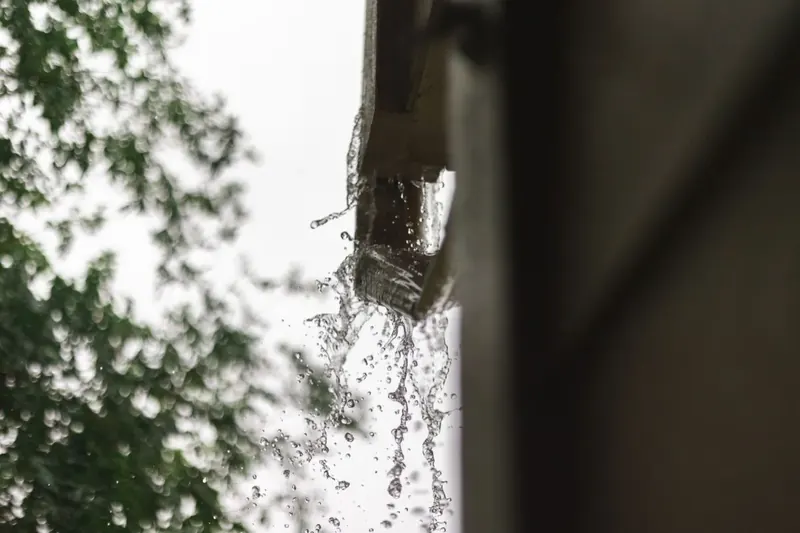
A gutter has one job: catch the water coming off the roof and move it to a downspout before it spills over the front edge. When the gutter is too small for the roof above it, water sheets over the lip in heavy rain, soaks the ground along the foundation and splashes back onto siding. Over time that shows up as wet basements, rotted fascia and peeling paint.
Most homes in Central New York do fine with 5-inch K-style gutters. Some homes really do need 6-inch. The difference comes down to how much roof drains into each run, how steep it is, where valleys concentrate water and how hard the rain falls. A 6-inch K-style gutter carries substantially more water than a 5-inch and pairs naturally with larger 3x4 downspouts.
How do you figure roof drainage area?
Drainage area is the square footage of roof that sheds into a given gutter run. It is measured on the roof footprint: the length of the eave times the horizontal distance from the eave back to the ridge. A 40-foot eave on a roof that runs 15 feet back to the ridge drains 600 square feet into that gutter.
Then adjust for pitch. A steeper roof catches more wind-driven rain on its face and sends water down faster, so installers multiply by a pitch factor. These are common industry rules of thumb:
| Roof pitch | Common examples | Pitch factor |
|---|---|---|
| Flat to 3/12 | Porch roofs, low additions | 1.0 |
| 4/12 to 5/12 | Many ranches | 1.05 |
| 6/12 to 8/12 | Typical colonials and capes | 1.1 |
| 9/12 to 11/12 | Steeper colonials, older farmhouses | 1.2 |
| 12/12 and steeper | Victorians, steep gables | 1.3 |
That 600-square-foot section on an 8/12 roof becomes about 660 square feet of adjusted drainage area. The adjusted area is then weighed against how much water each gutter size can carry at local rainfall intensity, along with how long the run is and how many downspouts serve it. A long run with a big roof above it and a single downspout at one end is the classic case for 6-inch.
Does rainfall intensity change the answer?
Yes. Gutters are not sized for average rain. They are sized for the hardest bursts, the five or ten minutes of a summer thunderstorm when rain falls far faster than the hourly total suggests. Central New York sees plenty of those storms from June through August.
Annual rainfall is not the number that matters. Two places can get the same yearly total, one from steady drizzle and one from a handful of downpours, and the downpours are what overflow gutters. That is why a gutter that seems fine in April can still spill during a July storm.
Why do roof valleys overflow 5-inch gutters?
A valley is where two roof planes meet in an inside corner. It works like a funnel, collecting water from both slopes and dumping it onto a few feet of gutter at high speed. On many homes, valley water shoots right over the front of a 5-inch gutter even when the rest of the run handles rain fine.
Common fixes include upsizing that run to 6-inch, adding a downspout close to the valley and installing a small splash guard at the corner to knock water back into the trough. One upsized run often solves a problem a homeowner has lived with for years.
Metal roofs behave in a similar way. Water sheds off smooth metal quickly, and snow tends to slide off in sheets. Homes with metal roofs often benefit from 6-inch gutters and closely spaced hangers. If the roof itself is due for attention, our metal roof resealing and painting service covers that side of the job.
2x3 or 3x4 downspouts: which does your home need?
The downspout is often the real bottleneck. A gutter can only drain as fast as its outlets let water out, and a 2x3 downspout is easy to choke with maple seeds, pine needles or a wad of wet leaves.
| Downspout | Opening | Typical use | Rough roof area per downspout |
|---|---|---|---|
| 2x3 | About 6 sq in | Standard on 5-inch gutters and smaller roofs | Up to roughly 600 sq ft |
| 3x4 | About 12 sq in | Standard on 6-inch; common upgrade on 5-inch | Up to roughly 1,200 sq ft |
A 3x4 downspout has about twice the opening of a 2x3. Coverage figures vary by source and by the rainfall assumptions behind them, so treat them as a starting point rather than a rule.
Switching 5-inch gutters to 3x4 downspouts is one of the most cost-effective changes for an overflowing system. Downspouts typically run $8–$14 per linear foot installed in Central NY. Adding an outlet to break up a long run also helps: a 50-foot run drained at both ends performs far better than one with a single outlet.
What about snowmelt, ice dams and snow load?
Upstate winters stress gutters in ways rain never does. Snow sits on the roof for weeks, melts on sunny afternoons and refreezes overnight.
Ice dams
Ice dams form when heat escaping through the roof melts snow and the water refreezes at the colder eave. Gutters do not cause ice dams, and a bigger gutter will not prevent them. The real fixes are attic insulation, air sealing and ventilation. What good gutters can do is give meltwater room to move during thaws, and a properly pitched gutter drains instead of holding standing water that freezes solid.
Snow load and hidden hanger spacing
A gutter packed with ice is heavy, and snow sliding off the roof can hit it hard. Hidden hangers screw through the gutter into the fascia, and ideally into the rafter tails behind it. Spacing is what matters most. In milder climates, hangers are often set 24 to 36 inches apart. For Upstate snow loads, about 24 inches on center or closer is a sensible standard, with extra hangers near valleys and below steep roof planes.
Ask any installer what hangers they use and how far apart they will be. A vague answer is a warning sign.
Where downspouts discharge
Downspouts that empty onto a driveway or walkway create ice patches all winter. Plan discharge points away from foot traffic and away from the foundation, and use extensions to carry water out where it can soak in safely.
So which gutter size should your home get?
- 5-inch with 2x3 downspouts: smaller ranches and capes with simple roofs and short runs.
- 5-inch with 3x4 downspouts: typical homes where the gutters themselves are adequate but outlets clog or overflow in big storms.
- 6-inch with 3x4 downspouts: large two-story homes, steep roofs (roughly 9/12 and up), long runs, metal roofs and any run below a valley.
- A mix: 5-inch on most of the house and 6-inch on one or two problem runs. This is common and often the best value.
On cost, 5-inch typically runs $9–$15 per foot installed and 6-inch $12–$20. These are typical Central NY ranges; your written quote is free and exact.
Have your roof measured, free
The right size comes from measuring your roof, not guessing from the street. During a free in-person estimate, we measure each run, look at pitch, valleys and downspout locations, and recommend a size for each section. You get a written quote with gutter size, downspout size and footage spelled out.
Read more about our seamless rain gutters, which we roll-form on site from aluminum coil, then book a free estimate or call (877) 879-4616, Monday through Saturday, 9 to 5.